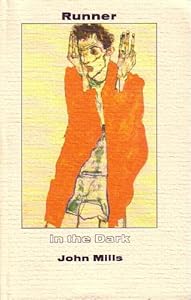
John Mills, author of "Runner in the Dark" is a Vancouverite whose past experiences includes working for the Distant Early warning (DEW) -line as a radar technician. The DEW-line was built in the late 1950s by the American government as a form of defence during the Cold War . Its purpose was to detect any signs of an air strike from Europe or Asia that would be detrimental to both Canada and the United States of America. Radar sites were set up along Northern Canada and Alaska. Technicians like John Mills were responsible for installing the radar machines - a complicated skill. Both Canadians and Americans were recruited to complete the DEW-line.
View more on the DEW-line story here.
Today, the DEW-line is of no use as technology has evolved. Ironically, Canadians have taken on the task of cleaning up the American project. Defence Construction Canada (DCC) calls this project "DEW Line Clean Up" in which their goal is to protect the northern environment from contaminants and debris left over from the DEW-line (DCC, 2013). These would include metal, paint, fuel, batteries, and electrical equipment. This Canadian crown corporation have used innovative engineering and archeology to create a specific clean up plan that considers all geological factors, like permafrost, terrain, and hydrology (DCC, 2013). This project is to be finished this year, hopefully restoring the northern environment close to its original state.
View Undoing the DEW.
DCC has used their technology not for defence, but for the protection of land. Although this clean up is not occurring in Vancouver, it does reflect Vancouver's sustainability. I believe that Vancouver has taken on this character and has chosen it to be one of its defining traits. Vancouver is also using technology to restore the environment as close to its original state as possible, as evidenced by the "Greenest City 2020 Project". This project employs various interventions that will make Vancouver the greenest city in the world by 2020. Like the DCC's Dew Line Clean Up Project, the Greenest City 2020 Project plans on reducing contaminants to the environment. For example, new building policies were initiated by the council that would allow new homes to be carbon neutral. By including certain technology in new homes in Vancouver, the home itself will contribute to the the sustainability of the environment. One policy that was initiated is that all bulbs in homes must be energy efficient, like compact fluorescents or light emitting diodes (City of Vancouver, 2012). Click here to view an interactive model of the policy changes made on building regulations in Vancouver.
Sources:
City of Vancouver. “Greenest City 2020: A Bright Green Future.” https://vancouver.ca/green-vancouver/a-bright-green-future.aspx (Vancouver B.C.: City of Vancouver. 16 November 2012)
City of Vancouver. "Green Home Building Policies." https://vancouver.ca/home-property-development/green-home-building-policies.aspx (Vancouver B.C.: City of Vancouver. 19, June 2012)
Defence Construction Canada (2013). "DEW Line Clean-Up." http://www.dcc-cdc.gc.ca/english/pr_dew.html Last Accessed on July 5, 2013)
Internet Archive (2001). "Dew Line Story." http://archive.org/details/gov.archives.arc.52896 Last accessed on July 5, 2013)
